Welcome to Diane’s Blog!
I’ll use this spot to chart what I enjoy and endorse, as we attempt to live a life of style in a culture of business and writing and art.
And I hope you join me; share your own stories, insights and ideas about living a creatively expressive life.
Monday, July 09, 2012
One of the best pieces I’ve read about the latest Costume Institute
exhibit at the Metropolitan Museum, “Prada & Schiaparelli,†is in this week’s issue of City Arts. Read here: http://cityarts.info/2012/06/12/ugly-chic-the-couture-version/
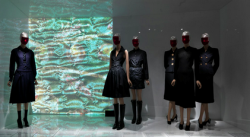
Until now, no one I’ve read has quite made the point I’ve always felt, that Miuccia Prada has, at the heart of her little ($6.5 billion) empire, a massive dose of contempt for her audience. “Bad taste is part of our culture, †Prada is quoted as saying, as though that excuses her use. And City Arts reviewer, Mona Molarsky allows the fact that “Prada’s clothes tend to have a dowdy line that conjures up images of harried housewives, Catholic schoolgirls and disheveled cross-dressers.†It is clear the choices Prada makes are deliberate. What underlies those choices, however, is a dose of condescension uglier than any of the clothes she might design. A nasty choice, I think, for a self-avowed Communist, when the idea of mocking the bourgeoisie is more appealing than teaching or leading.
Prada’s avowed heroes, Bunuel and Antonioni (among my heroes too, by the way), may also have held the striving rich at an emotional distance, and may also have pushed the limits of propriety. But their attempts to air-out the staleness of an insulated and over-protected world moved their culture forward. They led, they shared, they opened windows with their art. I can’t imagine what they would make of Miuccia, who has perverted what may indeed be considerable gifts of talent and intellect to create gestures no greater than a mocking smirk. What’s particularly irritating is that Prada, who was born into a privledged family, has become even more fabulously wealthy by doing exactly that. Sneering. Far richer than Bunuel or Antonioni or, for that matter – Schiaparelli.
Unlike Prada, Schiaparelli’s genius, like that of her fellow Surrealists, lay in the liberating nature of imagination, and their belief in a movement that suggested mankind might prosper in its freedom. Schiap’s ability to weave iconoclastic ideas into garments that also made one think (or at least smile) came from an idea that style and art were not removed from one another, not mutually exclusive concepts.
The fact that the eye can only be renewed by challenge, and that challenge is sometimes interpreted as ugly, may be true, but it only works so far. Schiaparelli’s clothes were witty and sometimes outrageous – but they were, nearly always, beautiful. And even when she’s making the point of challenging our concept of adornment, her proof is in the absolute. It may be a lobster of the scale and color you’d find in a seaside clam bar; you may never have imagined it rendered in seed pearls and sequins – but there it is. It should be tacky. It should be terrible. But it is, impossibly, undeniably - beautiful.
The City Arts piece suggests that Schiap meant to lampoon the upper crust of England and Europe by dressing them in outrageous garb while the carnage of World War 2 fell about them. The irony may not have been lost on her, but I very much doubt it was her aim. The Surrealists were far beyond mere cultural comment. The life of the mind, the idea of art as part of the revolution of imagination, fueled the Surrealists – from Apollinaire to Leonor Fini to Schiaparelli. By juxtaposing objects, stripping them of their normal or apparently defined significance, one could release something powerful and unconscious that might come closer to the natural, uncorrupted spirit one might call freedom. Magritte, Ernst, deChirico. It’s an Art with a mission.
The fact that Elsa Schiaparelli’s art was hung on shoulders, rather than museum walls, is to me, a slender difference. Like the ancient gold and jeweled cuffs and crowns of primitive warriors, the fact of adornment as art, almost makes the point of art that much more powerful. I was so excited to see that she was to be honored by the Met, and so very disappointed in the pairing of her work with a designer whose greatest talent lies in the art of the sneer.
(0)
Comments •
Wednesday, June 27, 2012
Last night Nora Ephron died. It seems impossible to write this. A planet without Nora Ephron is nowhere near as nice a place to live. I’d been a fan since I was a teenager, inhaling her columns in the fledgling
New York Magazine and
Esquire. Her byline may be the first I ever sought. I bought
Crazy Salad at Rizzoli’s the day it launched in 1975, took it home and realized, to my delight, that I’d read almost every article reprinted therein. I had remembered phrases verbatim. In the world before the Internet, the idea of calling back an article from an issue of a magazine tossed years before, was rare enough, but Ephron’s words stuck. She wrote in ways that were both original and familiar – at least to a young New York girl who was sure that no one, familiar or otherwise, was likely to appreciate my own off-center brand of original. Role models for funny women were few and far between and when you tried to find that wacky blend of intellect and domestic insight that made up my own imagination, they were all but missing. Excepting Ephron. She became for me a touchstone and a beacon. Like Wendy to the Lost Boys, Nora Ephron was a member of the Men’s Club Neverland of New Journalism that suggested the fresh but sophisticated, witty world I hoped would welcome me.
Two years ago, I sat next to Nora at dinner and we talked about the difficulty of women making films. I had to pinch myself. I was sitting next to the woman who had defined for me the idea that women who didn’t use beauty or sex to define value, could, in spite of so much evidence to the contrary, be successful. Smart. Funny. Funny trumped it all, because to me, if it wasn’t smart, it wasn’t ever going to be funny. Still, that night she shared some hard truths including the insight that being Queen of the Hill was not all it was cracked up to be. There was a film she’d always wanted to do, she explained, but she could not raise financing. She’d tried for years. Decades. Wrap your head around this: Nora Ephron couldn’t make the movie she longed to make. The excuse she was given over and over again was that women’s projects didn’t sell well internationally to the mostly male audiences who consumed action films. Swathes of young men don’t need to understand English or nuance or cultural tics when the screen is full of warriors battling giant robots, or aliens, or dinosaurs, or rogue waves.
We could question the intelligence of an industry that doesn’t seem to appreciate the fact that generations of movie viewers have consumed
Casablanca,
Philadelphia Story and
Annie Hall in every form from the
Million Dollar Movie (pulling in its Maxwell House millions in advertising) to VHS cartridges, to CDs, and now as downloads. We could try to discuss with a minimum of chest beating, the ethics of exporting, in large doses and as the largest proportion of the art, the lowest possible quality of material designed only to raise the highest possible level of blood pressure in its audience. We could talk about data that proves that while treated like a fringe minority, the demographic of women over 40 is the largest, richest segment of an affluent, culture-consuming population. But even if we believe in the economics of action films, how does one explain that Wes Anderson (
Royal Tannenbaums,
Rushmore, Life Aquatic), Spike Jonz (
Adaptation, Being John Malkovitch), Clint Eastwood (
Gran Torino, Bridges of Madison County) and a dozen other boy directors get funding to create whatever they want to make, year after year. Can you imagine an audience of young men in Saudi Arabia grasping the nuance of Susan Orleans dealing with Chris Cooper’s toothless orchid grower in
Adaptation? Does this make economic sense? Nora Ephron made
Sleepless in Seattle, for god’s sake. She wrote
When Harry Met Sally. Her movies have, on average, made hundreds of millions of dollars. Hundreds of millions more, in fact, than
Adaptation or
Royal Tenenbaums, And, like
Casablanca, her films will almost certainly continue their return on investment for generations long after we’re gone.
She was frustrated. She didn’t understand it either. And I thought as I sat there, bowled over by her clear, candid talk from the top of the mountain,
Well, you’re Nora Ephron. You’ve got connections and power. You’ve got time on your side. I’ll wait. You’ll figure it out. I didn’t know that she didn’t have time.
Kathryn Bigelow, the only woman director to win an Academy Award, did so with a film about war and a cast that was 99% male. Bigelow apparently figured it out. Skilled and strong and powerful as it is,
Hurt Locker has almost nothing at all to do with the average woman’s day to day life. And, as my great grandmother would say, more’s the pity.
We will all miss Ephron’s wit and wisdom. The outpouring of love and respect from her friends and family is as heartwarming as it is heartbreaking. And I will have to get used to the terrible idea that it’s time to stop waiting for Nora Ephron to figure out where to find the money. I’ll have to stop looking forward to that wonderful, glorious film that would, almost certainly, speak directly to me and point the way. Just as she always did.
(0)
Comments •
Friday, June 22, 2012
This past weekend Frank and I were treated to a Bloomsday event that touched and delighted us, not only for its quality, its attention to detail, its pitch-perfect manners, but also for its overwhelming generosity. And about events - I don’t give complements lightly.
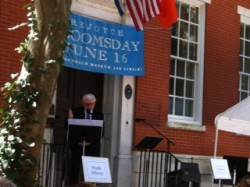
Here at MEIER, we have thirty years of client launches, anniversaries, market week events and corporate celebrations under our collective belts. We spent more than a million dollars in one evening for the fiftieth anniversary of a great magazine, we wrote and produced a book about the state and style of weddings across America (which required some serious study about celebrations, marital and otherwise). We’ve a history of managing top-notch market-do’s, from fashion to food, to retail - and we even considered launching a Neiman Marcus Christmas book with a real live cattle drive up Seventh Avenue. Okay, the mayor’s office proved more difficult to wrangle than the actual cattle promised to be – but – I’m just sayin’ – we’ve been there. And my praise for throwing the Great Event is not earned lightly.
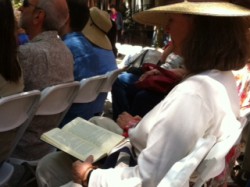
The Rosenbach Museum and Library in Philadelphia cleared all evidence of pre-Ulysses life (parked cars, most notably) from Delancey Place to set up a thousand chairs and make room and welcome for James Joyce and the love of that surrounds him and his great
Ulysses. Their fourteenth annual Bloomsday celebration encompassed celebrities, singers, dignitaries, musicians and readings by the neighbors and friends of The Rosenbach. Perfectly timed, perfectly chosen. The audience was more than half the equation, attentive and comfortable in a crowd of like-minded pilgrims, following along on their own texts – many of which were visibly scribbled with notes. And there they happily stayed, for hours and hours and hours. Marvelous.
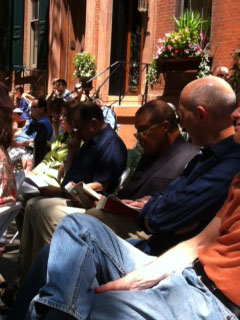
On an afternoon of incredible beauty – a great blue sky, the breeze rustling the papery leaves of the trees overhead, the dignity of the Rosenbach houses and the peaceful, quiet domesticity of the homes along Delancey Place, we heard the ancient Greek of Homer, read by one of Rosenbach’s brilliant archivists, set as our call to action. Ulysses was, indeed, on those shoulders. Frank followed with the lead passage – “Stately, plump Buck Mulligan….†and we were off and running. Through the day, singers of arias as rich and true as you’d find on a stage at the Met, and tenors singing songs Joyce may have sung himself, blended in perfect harmony with passages chosen to move us through the chapters of
Ulysses in understanding and celebration. Someone must have made a pact with the ghosts of Sylvia Beach and Harriette Weaver. It seems as though they’re still watching out for their Jim. No sirens, no thunder, no squabbles. Not a song was lost. Not a chair was broken. No babies cried. Even the dogs held their barking for applause.
Frank writes movingly about the day here. I can only second the motion, but do so with great enthusiasm, and advise: If you have next year’s diary at hand, write in: “Philadelphia – Bloomsday - Rosenbach†right now, and make a reservation at a hotel near Rittenhouse Square. Or call your old college roommate – the one who lives in Philly - and ask if you might sleep on his couch next June 16th. It’s “worth the trip,†as Michelin used to say. It was, in short, the new standard of “How to throw a Bloomsday.†Never to be forgotten, I am so grateful I got to accompany their headliner.
(0)
Comments •
Friday, October 21, 2011
Actually - my wonder-boy-agent, Mitchell Waters made us do it... or at least lobbed the suggestion that we contribute to an anthology of short stories about or including Jane Austen. We thought it sounded like fun, and a great place to test a couple of urbane married-to-one-another amateur sleuths we'd been thinking about creating. Together we joined forces (and keyboards) and created a short story called, "Faux Jane" for the anthology, "Jane Austen Made Me Do It".
And we'll talk about all of this with Scott Simon on National Public Radio this coming Saturday morning! Frank and I even share a reading! Yikes!
Most Weekend Editions seem to play between 8am and 10am on Saturday morning, but check your local listing and tune in!